
Canadian Scrap Car SEO Case Study: 40 Inquiries in 22 Days
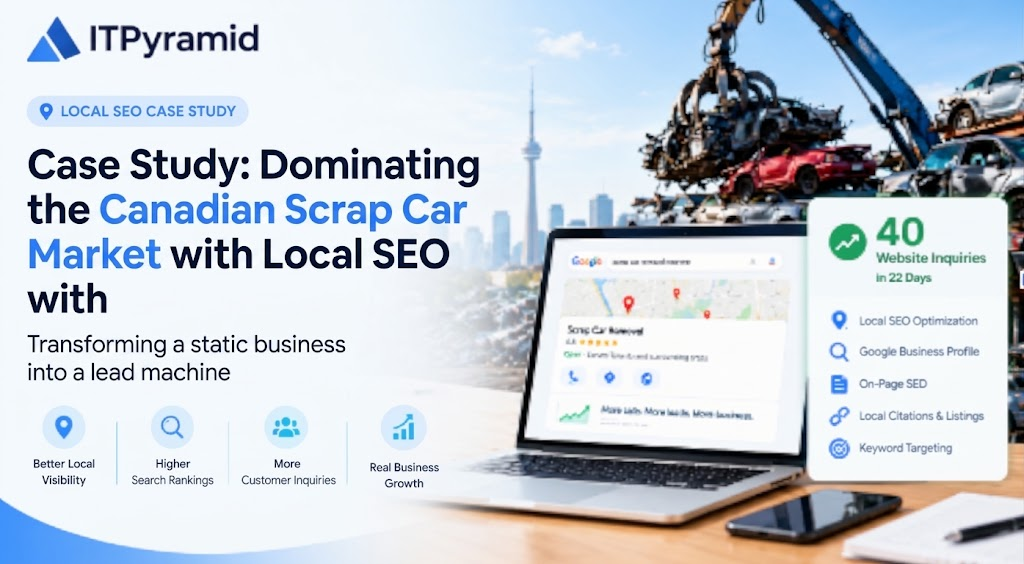
Executive Summary: Zero to 40 High-Intent Leads in 22 Days
A Canadian scrap car business, struggling with an invisible online presence and total reliance on traditional word-of-mouth, partnered with IT PYRAMID to reverse years of digital stagnation. Despite serving over 40 distinct service areas, their existing website generated zero inquiries. Within four months of our specialized local SEO overhaul, the business achieved a complete digital turnaround.
This breakdown details the exact results and the 7-step conversion-focused strategy implemented to transform a ‘digital brochure’ into a dynamic, customer-centric lead machine.
The Metrics That Drive Growth: Verified Results (Oct 1–22)
Our strategy prioritized high-intent visibility and lead volume over generic rankings. The following data, drawn directly from verified performance dashboards, illustrates the dramatic shift in October, encompassing just 22 days:
Immediate Impact on Website Conversions
- Total Website Inquiries: 40 qualified leads (phone calls and contact form submissions).
- Conversion Rate (Form Fills): 11.2% (estimated, a profound shift from a baseline of zero).
Aggregated Organic Performance (Search Console)
- 136 Clicks: Highly targeted commercial intent traffic.
- 25.7K Impressions: Rapidly expanding visibility across their expansive service areas.
Hyper-Local Dominance (Google Business Profile)
The Google Business Profile (GBP) was transformed into the fastest-acting component of the lead generation ecosystem:
- 110 Total Interactions on Profile.
- 43 Direct Phone Calls originating from the profile.
- 12,500+ Profile Views (across the 4-month optimization period).
- 1,742 Total Search Query Matches (top term: “scrap yard,” generating 281 unique searches).
Contextualizing the Data: Visibility vs. Commercial Intent
Critics may point to the business’s average position of 42 in Search Console and assume the strategy underperformed. This is a naive interpretation of local SEO data. That average includes thousands of broad, informational long-tail keywords that we targeted for long-term topical authority.
The metric that matters to a business owner is commercial conversion. Our primary target keywords—those with massive commercial intent (e.g., “sell my scrap car [City]”)—are consistently ranking in the Top 3 positions across multiple core service areas, translating directly into high-converting customers.
Want to learn more about keyword research
The Original Diagnosis: Analyzing Strategic Failure
Before our intervention, the client faced systemic challenges typical of established local businesses that neglect their digital footprint.
1. A Static, Non-Converting Website
The site was functionally invisible. A passive “digital brochure,” it lacked clear calls-to-action (CTAs), a mobile-first design, or any pathway for a customer to quickly understand how to sell their vehicle.
2. Neglecting Customer Intent and Core Questions
The site had zero content addressing real customer anxiety. A seller wants immediate answers: How much cash will I get? Will you tow it for free? What documents must I sign? Do you buy cars with accidents? The old site answered none of these, missing major opportunities for ranking and conversion.
3. Geographic Invisibility
The business was willing to serve 40+ areas but had zero location-specific targeting on its domain. Google had no localized content signals to suggest the business was relevant in adjacent cities, limiting their potential reach by over 90%.
4. Google Business Profile (GBP) Abandonment
Their most vital local tool was forgotten. Categories were inaccurate, services were incomplete, images were non-existent, and a structured review acquisition strategy was absent. The GBP was providing zero commercial value.
The 7-Step IT PYRAMID Transformation Strategy
We executed a phased, exhaustive local growth plan focusing on technical performance, strategic content depth, and conversion optimization.
Step 1: Complete Conversion Architecture Rebuild
The entire digital property was rebuilt from the ground up on a lean, mobile-responsive framework. We prioritized rapid page speed (targeting Core Web Vitals compliance) and immediate conversion paths. The new interface prominently places simple inquiry forms and ‘one-click to call’ buttons. Every design decision serves a single purpose: making it easy for an anxious seller to contact the business immediately.
Step 2: Semantic Content and Search Intent Realignment
We moved beyond simple keyword stuffing. Our team meticulously analyzed the language customers used during phone inquiries and in “people also ask” sections. We mapped specific pages to high-intent questions (e.g., “how to sell a car without ownership in [City]”). This prepared the website for success in AEO (Answer Engine Optimization) and future-proofed the content for GEO (Generative Engine Optimization) platforms like ChatGPT and Gemini.
Step 3: Geographic Dominance via 40+ Unique Location Pages
We rejected the industry-common, spam-vulnerable tactic of duplicating one page and swapping city names. Instead, we developed 40+ individually crafted, distinct location pages. Each page integrates unique local data, structured service-area schema markup, specific localized FAQs, and custom content relevant only to that exact city. This semantic depth signals hyper-local relevance to Google, allowing us to dominate search results across a massive geographic radius.
Step 4: Integrated Optimization (SEO, AEO, and GEO)
Traditional “ten blue links” optimization is insufficient. We integrated a three-pronged strategy:
- SEO: Optimizing for traditional localized keyword ranking.
- AEO (Answer Engine Optimization): Structuring content (lists, tables, clear direct answers) for question-based queries that power voice search and featured snippets.
- GEO (Generative Engine Optimization): Ensuring our structured data and entity relationships are intelligible to AI-powered generative search engines.
Step 5: Advanced Technical SEO and Schema Deployment
We implemented robust structured data (Schema.org) across the domain, including specific LocalBusiness and FAQPage schema. This allowed Google to explicitly understand the business type, service areas, customer pricing models, and hours. We prioritized technical crawlability, a flat site architecture, and rigorous testing for page speed performance on mobile devices.
Step 6: Building Authentic Local Authority
Our off-page efforts focused entirely on quality
y over quantity. Instead of buying irrelevant directory links, we worked on building legitimate local citations with impeccable NAP (Name, Address, Phone) consistency. We focused on highly relevant, authoritative links from Canadian automotive and local business niche sources, signaling genuine expertise and trust.
Step 7: Optimizing the GBP into a Lead Generation Machine
The GBP optimization was executed as a priority task. We corrected the primary category, expanded and refined the service lists with precise descriptive keywords, and implemented a recurring posting schedule (3+ per week). We established a system to acquire authentic, verified reviews and uploaded authentic, high-resolution media (photos/videos) of real vehicle purchases. This transformed the profile from an empty placeholder into a primary lead source.
Conclusion: The Local SEO Growth Model
The remarkable transformation of this Canadian scrap car business was not accidental. It was the direct result of a calculated strategy that prioritized conversion potential over vanity metrics. Success in local SEO today requires deep customer empathy, technical precision, and a multi-platform understanding of intent.
If your local business is invisible online and reliant on static reputation, contact IT PYRAMID today to discuss how we can engineer a similar growth trajectory for your organization.
Ready to improve your website’s search rankings and attract more customers?


 I’ve gotten a number of works do e by Sandra Smith of IT Pyramid, from pictures, character designs and animations to vtuber models. The quality has always been top notch and i can’t recommend them highly enough.